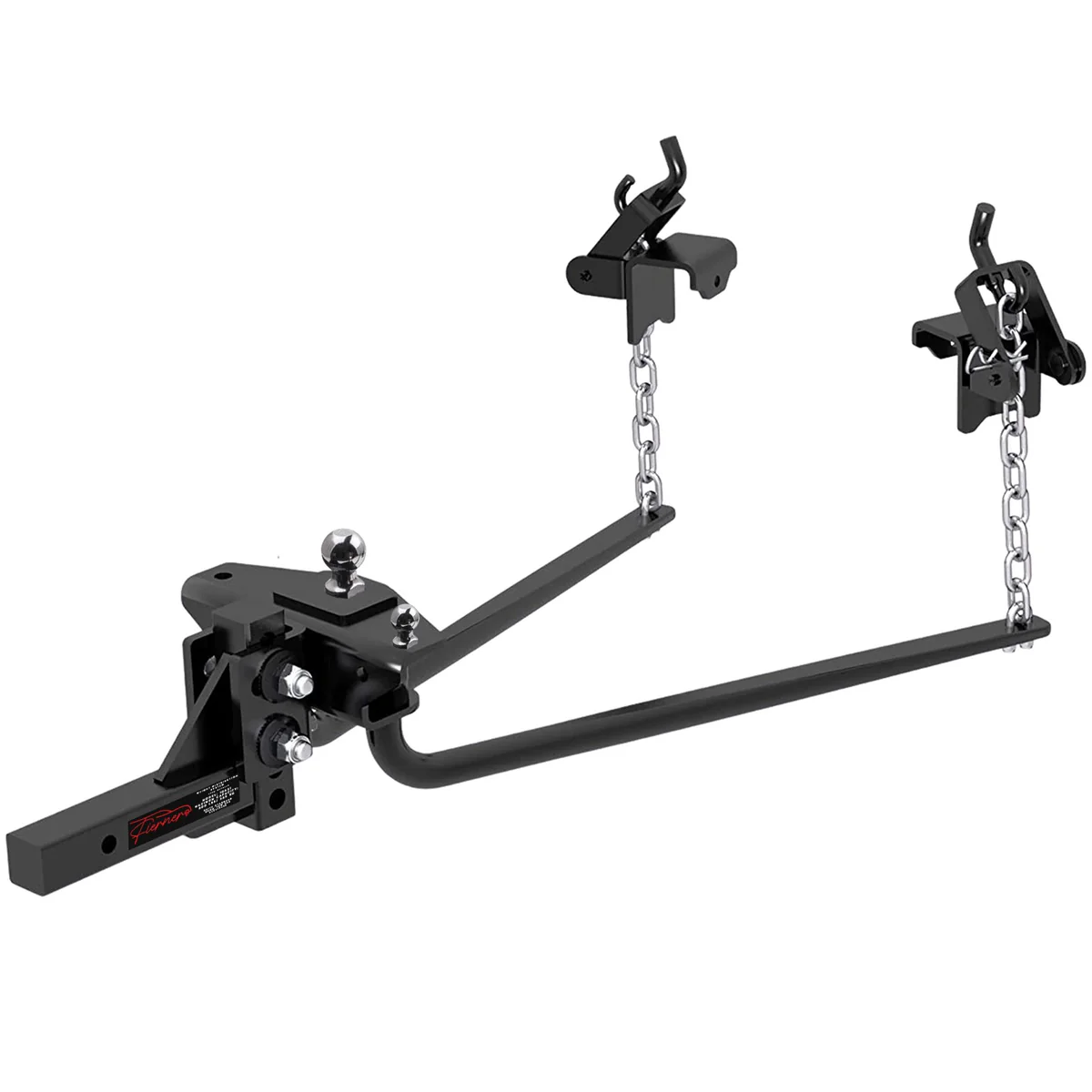
To explain how a Weight Distribution Hitch (WDH) works, it helps to first understand the problem it is designed to solve: the “Teeter-Totter” effect.
Here is a breakdown of how the WDH interacts with your tow vehicle and caravan to correct this issue.
1. The Problem: The Teeter-Totter Effect
When you lower a heavy caravan coupling onto your vehicle’s tow ball, all that weight (tongue weight) pushes down on the vehicle’s rear axle.
Because the rear axle acts as a pivot point (fulcrum), two things happen:
-
The Rear Squats: The back of the tow vehicle creates a “sag.”
-
The Front Lifts: The front of the tow vehicle rises up.
Why is this dangerous?
-
Steering: Your front tires lose contact pressure with the road, making steering “floaty” or unresponsive.
-
Braking: Front brakes provide the majority of your stopping power. If there is less weight on them, you cannot stop as quickly.
-
Visibility: Your headlights point up into the sky (or oncoming drivers’ eyes) rather than at the road.
2. The Solution: How the WDH Interacts
A WDH stops the tow vehicle and the caravan from operating as two separate hinged units and forces them to act more like a single, rigid frame.
It achieves this through Spring Bars. These bars attach to the hitch head on the vehicle and are then leveraged up and chained (or bracketed) to the caravan’s A-frame.
The Wheelbarrow Analogy
The best way to visualize this interaction is to imagine a wheelbarrow:
-
The Caravan is the wheelbarrow bucket.
-
The Hitch is the wheelbarrow handles.
-
The WDH Spring Bars are you lifting the handles.
When you lift the handles of a wheelbarrow, you aren’t removing the weight of the load; you are leveraging it. Two things happen:
-
Some weight shifts forward onto your arms (the Tow Vehicle’s Front Axle).
-
Some weight shifts backward onto the wheelbarrow’s wheel (the Caravan’s Axles).
3. Where does the weight go?
The WDH does not “remove” weight from the total rig; it redistributes it across all axles.
4. The Interaction in Motion
Once the WDH is engaged, the interaction changes how the rig handles dynamic forces on the road:
-
Bridge Effect: The tension in the spring bars creates a “bridge” across the coupling. This resists the natural tendency of the vehicle and caravan to hinge vertically over bumps.
-
Friction & Sway Control: Many modern WDH systems rely on the friction of the steel bars sliding on the brackets to resist side-to-side movement, effectively acting as a sway controller.
-
Ride Comfort: Because the vehicle is level, the suspension travel is restored to its neutral position, allowing the shock absorbers to dampen bumps effectively rather than being fully compressed.
Summary
Without a WDH, the weight is concentrated on the vehicle’s rear axle. With a WDH, the tension creates a lever that spreads that weight across all three sets of axles (Vehicle Front, Vehicle Rear, and Trailer).